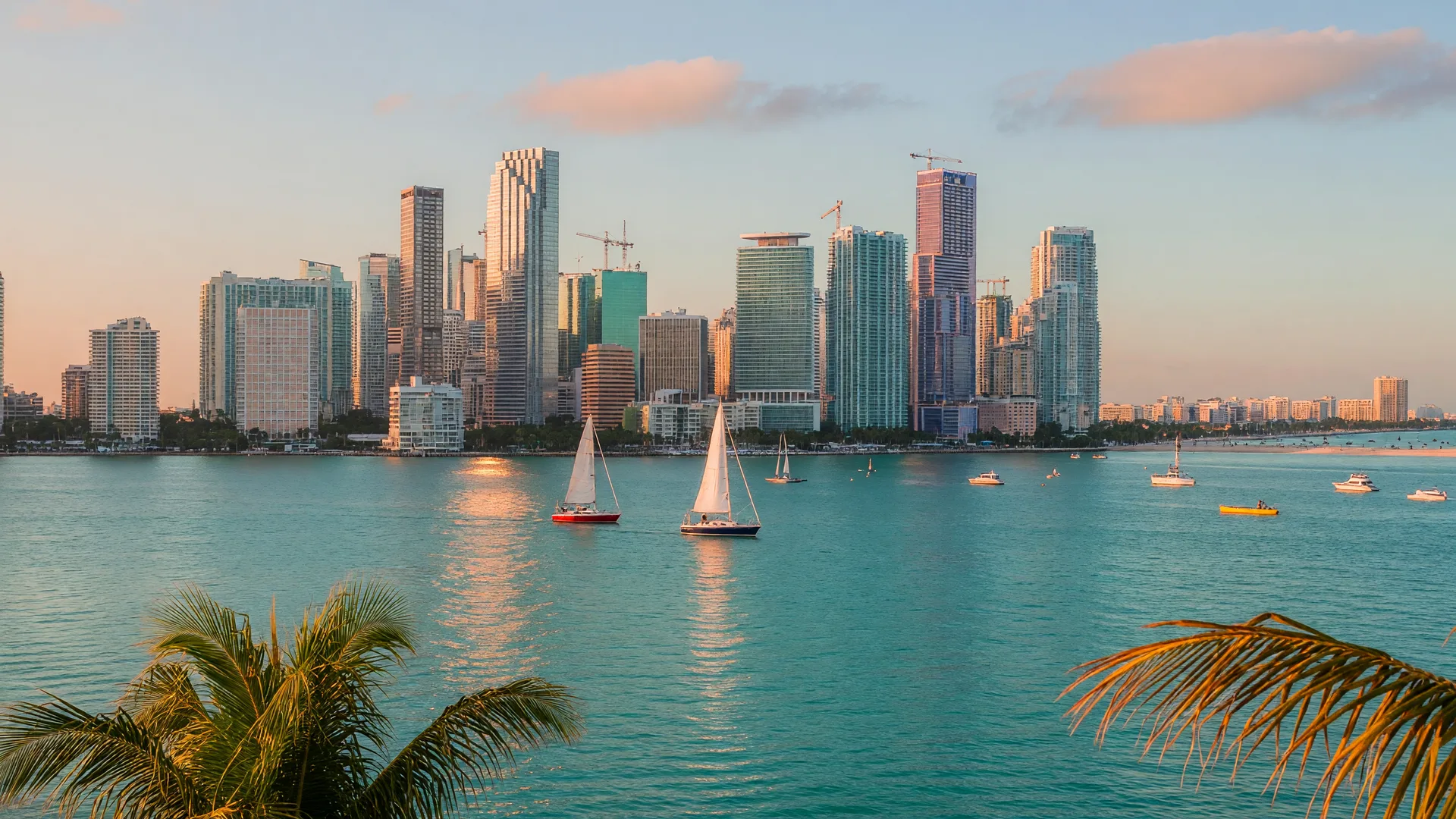
Moving from Greater Philadelphia to Miami or greater South Florida is a change of roughly 1,190 miles and about a 22-hour drive, and it lands you in a market that works differently on almost every axis: no state income tax, a housing market built around condominiums and waterfront development, homeowner's insurance that can run five figures, hurricane season from June 1 to November 30, and year-round heat and humidity. This guide covers the real, verified differences a Philadelphia-area buyer or seller should know before making the move, from commuting across the Miami metro to the tax math, the housing comparison, the schools, the weather, and what daily life actually feels like.
Here is what this guide covers: how the Miami metro is laid out and what commutes really look like; the taxes that disappear and the taxes that appear when you move from Pennsylvania to Florida; how cost of living and housing prices compare with Greater Philadelphia; property taxes and the insurance reality of coastal Florida; the school situation in Miami-Dade and Broward; hurricane season and the climate; and the lifestyle differences that are easy to underestimate. It ends with a personal introduction: Smarty's trusted Miami resource, Kelby Contreras, a Real Estate Advisor with Compass, for the South Florida side of your move.
The Short Version
- The average one-way commute across the Miami metro is about 29 minutes, but the region sprawls: downtown Miami to Fort Lauderdale is roughly 25 to 30 miles, 35 to 45 minutes off-peak and 60 to 90 minutes in rush hour.
- Florida has no state income tax. Pennsylvania charges a flat 3.07% income tax, and Philadelphia residents also pay a city wage tax of roughly 3.7%, about a 6.8% combined hit on earned income.
- Miami is generally the more expensive metro, and the gap is concentrated in housing: Miami-Dade's median single-family sale price ran about $665,000 in late 2025, versus a $420,000 metro median in Philadelphia.
- Homeowner's insurance is the budget surprise: typical Florida premiums run roughly $4,400 to $5,700 a year, and flood insurance is required with a federally backed mortgage in FEMA flood zones.
- Housing stock is different: condos, waterfront, and new construction dominate, and price per square foot rises sharply in luxury preconstruction towers, from roughly $527 a square foot across Miami's condo market to $1,000 or more in luxury buildings.
- The school picture is a trade-off: Miami-Dade and Broward districts rate A- overall, with elite magnets like MAST Academy, DASH, and the School for Advanced Studies at the top, while the best suburban Philadelphia districts still rate A+.
- Smarty introduces you to Kelby Contreras of Compass, his trusted Miami resource, so both sides of your move are coordinated from month one.
The Numbers
~29 min
Average one-way commute in the Miami-Fort Lauderdale-West Palm Beach metro (U.S. Census ACS)
0%
Florida state income tax, versus Pennsylvania's 3.07% plus a roughly 3.7% Philadelphia wage tax for residents
$665K
Miami-Dade median single-family sale price in late 2025 (MIAMI REALTORS), versus $420K in the Philadelphia metro
$5K+
Typical annual homeowner's insurance in Miami, with Florida premiums running near the highest in the nation
Commute and Geography: Understanding the Miami Metro
The single biggest adjustment for a Philadelphia-area transplant is scale and layout. The Miami-Fort Lauderdale-West Palm Beach metro is Florida's largest, home to roughly 6.1 million people, and it runs north and south along the coast for dozens of miles. The average one-way commute in the metro is about 29 minutes by Census figures, and in Miami-Dade County it is closer to 31 minutes, but averages hide the real story: the region is car-centric, multi-polar, and its geography matters more than its mile markers.
Downtown Miami and Brickell. The urban core sits at the metro's southern end of the business districts. Brickell is effectively adjacent to downtown Miami, the city's financial center, and both anchor the skyline you see from Biscayne Bay. This is where condominium living dominates and where many professionals live a short walk from work.
Miami Beach. Across the MacArthur Causeway, about 6 miles from downtown, sits Miami Beach, a barrier island of its own pace and price point. Expect roughly 15 to 25 minutes in the car between downtown and the Beach outside of rush hour, and plan around the causeway bridges when the sun is rising and setting. In one city you get the urban core; across the bridge you get the beach lifestyle.
The middle and southern suburbs. Coral Gables and Kendall sit southwest and south of downtown. Coral Gables is about 7 miles from downtown, roughly 15 to 20 minutes. Kendall stretches south, 11 to 17 miles from downtown and 20 to 30 minutes by car, with a Metrorail line running from Kendall to the Government Center downtown as an alternative.
Fort Lauderdale and Hollywood. Broward County begins about 25 to 30 miles north of downtown Miami. Fort Lauderdale is roughly 35 to 45 minutes off-peak on I-95, but 60 to 90 minutes in rush hour. Hollywood sits between the two, about 20 miles north of downtown Miami, a 25 to 35 minute drive. Workers who commute between the counties plan around I-95, the Florida Turnpike, and US-1, with Tri-Rail and Brightline train service as rail options.
Downtown & Brickell
The financial core of the metro, dominated by condo towers and walkable office districts. Brickell sits adjacent to downtown Miami, making it the natural landing spot for professionals. The MacArthur Causeway to Miami Beach is about 6 miles.
Miami Beach
A barrier island with its own housing market: oceanfront and bayfront condos, older Art Deco inventory, and a heavy share of ultra-luxury new construction. Commutes cross causeways that back up at rush hour.
Coral Gables & Kendall
Family-oriented suburbs southwest and south of downtown. Coral Gables is a historic, pedestrian-scale city about 7 miles out; Kendall stretches 11 to 17 miles south with Metrorail access and more single-family housing.
Fort Lauderdale & Hollywood
Broward County's coastal cities, 20 to 30 miles north of downtown Miami. Fort Lauderdale offers its own waterfront lifestyle and brightline rail; Hollywood is a closer, more affordable middle ground. I-95 rush hours run 60 to 90 minutes between the metro poles.
Florida Taxes vs. Philadelphia Taxes: What Changes at the State Line
The tax math is the cleanest win of the move, and it deserves an accurate breakdown. Florida has no state personal income tax, by constitutional prohibition: wages, salaries, pensions, and investment income are not taxed at the state level. Pennsylvania, by contrast, levies a flat 3.07% personal income tax that has held since 2004, and the City of Philadelphia stacks a wage tax on top for anyone earning in the city, roughly 3.7% for residents (and about 3.4% for non-residents who work in the city). A Philadelphia resident's earned income carries a combined hit of about 6.8%: 3.07% to the state plus roughly 3.7% to the city. Move to Florida and that line item drops to zero, which is a meaningful raise on paper for anyone with a salary, a pension, or investment income.
Sales tax works the other way. Florida's general sales tax is 6%, and counties add their own surtaxes, so the combined rate in most of South Florida is roughly 7% (up to 8% in some counties). Philadelphia's combined rate is 8%: Pennsylvania's 6% plus a 2% Philadelphia County local rate. So everyday shopping is roughly comparable, with a slight edge for Florida.
The full tax picture is not just income tax. Florida makes up revenue at the local level, and the two big line items are property taxes and insurance, covered in their own section below. Pennsylvanians should also know that Florida does not tax Social Security or pensions at the state level either, which is why retirees weight the ledger so heavily toward the state line.
Plan the transition year. The move itself can create a part-year tax situation in both states. Work through residency dates with a tax professional before the move, and check how your employer handles the transition from Pennsylvania withholding, the Philadelphia wage tax, and any local earned income taxes in your current PA county. The savings are real, and so is the paperwork in the year you move.
Cost of Living and the Housing Market
Across cost-of-living studies, Miami is generally the more expensive city than Philadelphia, and the gap is concentrated in housing. Estimates put the overall premium somewhere in the 15% to 27% range depending on the methodology, while groceries, utilities, and transportation run only marginally higher in Miami. RentCafe pegs Miami's average apartment rent at about $2,773 a month versus about $2,038 in Philadelphia, a roughly 36% gap. The takeaway: the everyday cost of living is comparable, and the housing column is where the budget bends.
Home prices. According to MIAMI REALTORS, Miami-Dade's median single-family sale price ran about $665,000 in late 2025, with the existing condo median at about $420,000, and the county's all-home median around $550,000. That compares with a $420,000 metro median in Philadelphia in mid-2025, so a Philadelphia-area buyer starts with a steeper price in Miami, before the other costs of coastal ownership.
Price per square foot. The county average runs about $387 a square foot, and condos and townhomes in the city of Miami average roughly $527. The luxury segment is where it separates: the median price per square foot in Miami's $2 million-plus condo market ran around $1,000 in late 2025, and newly delivered branded residences in Edgewater, Brickell, and South Beach list anywhere from about $1,400 to $2,800 a square foot. In Brickell, waterfront condos sell at roughly $929 to $1,016 a square foot against the area's overall average near $648. Philadelphia buyers used to row-home dollars should anchor on the $500 to $1,000 plus per-square-foot reality of premium Miami condo living.
New construction and preconstruction. South Florida runs one of the most active preconstruction markets in the country, and it behaves differently from resale. Preconstruction condos carried a premium of roughly 12% to 18% over initial release pricing through early 2026, which is the developer's price escalation as towers sell. Buyers negotiate deposit terms and closing timelines that are set years out, and financing a preconstruction purchase needs a lender who understands the market. If new development is your goal, this is exactly where a specialist like Kelby Contreras earns his keep.
What the comparison looks like head to head.
Greater Philadelphia
- Metro median sale price about $420,000 in mid-2025
- Mix of rowhomes, twins, and suburban single-family; strong established neighborhoods
- Pennsylvania income tax 3.07% plus Philadelphia wage tax around 3.7% for residents
- Cold winters, four seasons, snow about 13 to 22 inches a year
- Top suburban school districts rate A+ nationally (Lower Merion, Radnor, Tredyffrin-Easttown)
Miami & South Florida
- Miami-Dade median single-family price about $665,000; condo median about $420,000 in late 2025
- Condo, waterfront, and new construction dominate; luxury runs $1,000+ per square foot
- No Florida state income tax
- Year-round heat and humidity, no snow, hurricane season June 1 to November 30
- District-wide Miami-Dade and Broward schools rate A-, with elite magnet options
Property Taxes and Home Insurance: The Coastal Reality
Florida's effective property tax rate is lower than Pennsylvania's, and this is one of the things Philadelphia-area owners notice first. Tax Foundation data put Florida's effective rate around 0.7% to 0.9% of home value, versus roughly 1.1% to 1.6% in Pennsylvania. In Miami-Dade, total millage on the 2025 certified roll averaged about 18.5 mills, meaning about $18.50 per $1,000 of taxable value, and Florida's $50,000 homestead exemption trims the assessed base for owner-occupants. Philadelphia's own citywide rate runs about 1.4% of assessed value, and suburban PA counties can land well above that. On the millage side, Florida tends to win.
Insurance is where Florida takes it back, and then some. Florida's average annual homeowner's premium runs roughly $4,400 to $5,700, with some estimates higher, nearly three times the national average. Miami homeowners routinely see $5,000 or more a year, and coastal buildings carry separate hurricane deductibles, typically 2% to 5% of the dwelling coverage. For condos, those costs flow into monthly association fees, and buyers must ask what a building's insurance bill means for the HOA dues.
Flood insurance is a separate purchase and is often mandatory. Standard homeowner's policies do not cover flood damage. Lenders require flood insurance on any property in a FEMA Special Flood Hazard Area that carries a federally backed or regulated mortgage, which describes a large share of coastal South Florida. National Flood Insurance Program policies in Florida average about $938 a year, but premiums climb sharply with risk: several thousand dollars a year in high-risk zones, and more on beachfront property. Miami-Dade participates in the NFIP's Community Rating System, which earns residents a 25% to 35% discount on flood policies.
Budget test for your offer. Before you fall in love with a price, run the full carrying cost: mortgage, property tax based on the actual purchase price, homeowner's insurance at realistic Florida rates, flood insurance if the property sits in a flood zone, condo association dues, and hurricane wind mitigation. A condo that looks like a deal at $600,000 can carry $2,000-plus a month in association fees and insurance before the mortgage starts.
Schools: Miami-Dade, Broward, and the Magnet Option
The Miami area is served by two huge districts. Miami-Dade County Public Schools, the state's largest with roughly 320,000 students across about 580 schools, carries an overall A- grade from Niche. Broward County Public Schools, covering Fort Lauderdale and Hollywood with about 236,000 students, also earns an A-. The honest comparison for a Philadelphia-area family: the strongest suburban Philadelphia districts, places like Lower Merion, Radnor, Tredyffrin-Easttown, and New Hope-Solebury, rate A+ and rank among the best in Pennsylvania. District-wide, Miami-Dade and Broward are a notch below that peak, with an important exception.
The exception is the magnet system. Miami-Dade runs some of the most highly regarded public magnets in the country, and because they are public they are free. The School for Advanced Studies, a dual-enrollment high school on college campuses, is regularly ranked among the top schools in Florida, and its campuses rate A+. Design and Architecture Senior High (DASH) is an A+ arts magnet. MAST Academy, on Virginia Key, is a high-performing maritime and science magnet. Families who are willing to navigate magnet applications and waitlists can access elite public education in Miami-Dade, but the district-wide floor is not the same as an A+ suburban district.
How to research before you commit. School attendance zones in Miami-Dade and Broward are assigned by address, and boundaries change, so never assume a neighborhood from a map. Verify the exact feeder pattern for a property with the district, check the magnet application calendar, and if private or charter options matter, price them into the budget. This is one of the most common misses for out-of-state buyers, and it is exactly the kind of question a local agent answers before you write an offer.
Miami-Dade County Public Schools
The state's largest district, roughly 580 schools and 320,000 students, rated A- overall. District-wide test proficiency runs near the Florida average; the elite magnets carry the top-tier outcomes.
Broward County Public Schools
Covers Fort Lauderdale, Hollywood, and points north with roughly 334 schools and 236,000 students, also rated A-. A serious option for families choosing the Broward side of the metro.
Elite Magnets: SAS, DASH, MAST
The School for Advanced Studies (dual enrollment), Design and Architecture Senior High (arts), and MAST Academy (maritime and science) are nationally ranked, A+ public options with competitive applications.
Suburban Philadelphia Comparison
Districts like Lower Merion, Radnor, Tredyffrin-Easttown, and New Hope-Solebury rate A+ and rank high nationally, a reminder that the district-wide floor in South Florida trails the Philly suburbs' best.
Weather and Hurricane Season: Trading Snow for Storm Season
The Atlantic hurricane season officially runs June 1 to November 30, and Miami sits inside the hurricane-prone zone. Philadelphia, roughly 60 miles inland, does not. That single sentence changes your calendar: storm preparedness is a seasonal fact of life in South Florida, with evacuation zones, shutters, and storm supplies as standard household equipment. Buyers should learn their property's flood zone and evacuation zone before they fall in love with an address, and expect lenders and insurers to ask the same questions.
Heat and humidity. Miami's July highs average about 89 to 91 degrees, with overnight lows near 78, and humidity runs around 73% year-round. Summer heat is regularly broken by brief afternoon thunderstorms driven by the sea breeze. Philadelphia's July highs average about 87 to 89 degrees, so summer is not mild, but the similarity ends there: Philadelphia's humidity drops in other seasons and its winters are cold, with January lows around 25 degrees. Miami's average is exactly zero inches of snow, against 13 to 22 inches a winter in Philadelphia.
Rain. Miami gets roughly 59 to 62 inches of rain a year, heavily concentrated from mid-May to early October, against about 47 inches in Philadelphia spread through the year. Expect a pronounced rainy season and learn to love the 4 p.m. storm.
Plan around it. Air conditioning runs nearly year-round in Miami, and energy bills reflect it. Align your first hurricane season smartly: review insurance, know your zone, and if you are buying a preconstruction condo, ask when the building opens versus when hurricane protections matter. For Philadelphia-area transplants, the trade is a real one: no shoveling, no cold, and a storm calendar you have to respect.
Lifestyle: What Daily Life in Miami Is Really Like
Lifestyle is where Philadelphia and Miami diverge most, and it is worth being honest about both. Philadelphia is a four-season, walkable, transit-connected city with deep roots and snow. Miami is a year-round outdoor city built on the beach, the bay, and the water, where the calendar fills with boating, beach days, and al fresco dining. Greater Miami welcomes roughly 28 million visitors a year and runs on a tourism-driven service economy, which shapes everything from traffic to where people live.
Language and culture. Miami is a majority-Hispanic city, around 70% of the population, and Spanish is woven through daily life, business, and media in a way that is entirely different from Philadelphia. Depending on your family, that is a feature to celebrate or an adjustment to plan for, and English speakers manage fine, but the cultural texture is unmistakably Latin American and Caribbean.
Getting around. Despite the dense urban core, Miami is largely car-dependent. Parking, tolls on the Turnpike and causeways, and rush-hour bridges are everyday realities, and the transit network, including Metrorail, Tri-Rail, and Brightline, is improving but does not replace the car for most trips. Philadelphia's grid and transit habits will not map onto Miami without a rethink.
Neighborhood character. The metro is a collection of very different places: Brickell's new towers, Miami Beach's waterfront glamour, Coral Gables' Mediterranean streets, Wynwood's art scene, Coconut Grove's leafy calm, and the Broward cities to the north. Your neighborhood choice is really a lifestyle choice, which is why the guide ends the way it does: with a local professional who lives in those differences.
Meet Smarty's Trusted Miami Agent: Kelby Contreras
John Smart personally serves buyers and sellers throughout Greater Philadelphia and the Delaware Valley as his home market. He does not pretend to be your Miami expert, and that is exactly why Smarty Home Solutions maintains a vetted network of trusted real estate professionals in destination markets. For clients moving to Miami and greater South Florida, Smarty makes a personal introduction to his trusted partner there.
Kelby Contreras
Real Estate Advisor with Compass · Miami Beach, Brickell, Fort Lauderdale, Hollywood & Greater South Florida
Kelby Contreras is a Real Estate Advisor with Compass with more than 15 years of experience across South Florida and a specialty in luxury preconstruction and new construction residences, from waterfront condominiums in Miami Beach and Brickell to new development across the region. He holds a Bachelor in Finance and Investments, which serves his buyers and sellers well in a market where price per square foot, deposit structures, and carrying costs decide the deal. John recommends Kelby as his trusted Miami resource because he brings the same experienced, client-first guidance to the South Florida side of a long-distance move.
Fill out the short form and Smarty's team will take it from there. Your information stays private and is used only to connect you with Kelby.
For the Philadelphia side of your move, Smarty Home Solutions serves Philadelphia, Montgomery, Bucks, Chester, Delaware, and Berks Counties, with buyer help, seller options, and senior transition services. Start at SmartyHomeSolutions.com for the sale, and schedule a call with Smarty to line up both sides of the move at once.
