Key Takeaways
- +Huntingdon Valley remains a competitive, family-driven market in Montgomery County, with demand anchored by the Lower Moreland Township School District and large homes on generous, tree-lined lots.
- +Low inventory, strong local equity, and a premium location near PA-63, I-95, and the Pennsylvania Turnpike continue to support long-term home values.
- +For the most current sales figures, let Smarty pull a personalized market analysis for your exact search or property, because ZIP-level numbers change month to month.
Huntingdon Valley is the upscale, wooded community in Montgomery County that families discover when they want excellent schools, generous lots, and a short commute to Philadelphia. This market update looks at what is driving demand in 2026, who is buying, and what buyers and sellers should expect for the rest of the year, based on the market's fundamentals and local conditions.
Where Huntingdon Valley Sits in the 2026 Market
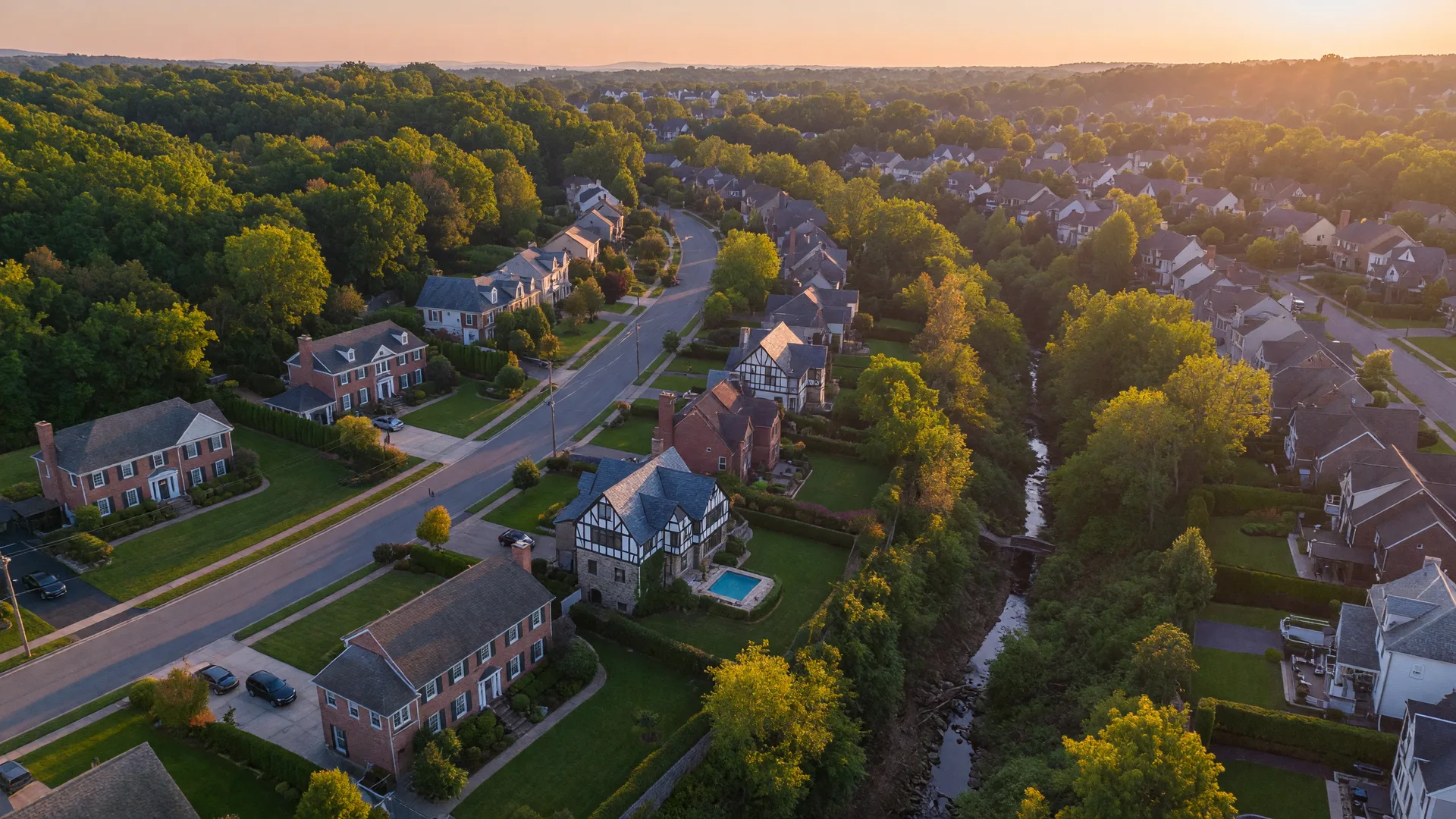
Huntingdon Valley (ZIP 19006) spans southeastern Montgomery County, straddling Lower Moreland Township and Bryn Athyn Borough, about 14 to 16 miles north of Center City Philadelphia. The community's character is defined by large single-family homes on big, tree-lined lots, quiet winding streets, and a deep network of parks that includes Lorimer Park and the Pennypack Preserve.
In 2026, that profile continues to make Huntingdon Valley one of the most consistent markets in the county. It does not move as fast as hot downtown corridors, and it does not crash the way resort or boom-bust markets do. It is a steady, fundamentally driven market: families buy for the schools, stay for the space, and trade up within the same few ZIP codes for decades.
The Housing Stock: Large Homes on Generous Lots
Unlike denser Main Line towns built on small in-town parcels, Huntingdon Valley's housing stock skews spacious. Classic Colonials, brick and stone Tudors, mid-century split-levels, and newer custom builds sit comfortably back from the street on lots that are noticeably larger than the county average. Mature oaks and maples arch over the roads, and creeks and preserves thread between neighborhoods.
That generous lot character is a core part of the value proposition. A buyer who compares a Huntingdon Valley home against a comparable house in Ambler or Glenside is often comparing a much larger yard, more privacy, and an immediate connection to trails and parkland. Estate-style properties and homes near Lorimer Park or backing to the Pennypack Preserve command the strongest demand and tend to hold value best in slower seasons.
The Lower Moreland Schools Premium
The single biggest driver of demand in Huntingdon Valley is the Lower Moreland Township School District. The district runs a compact K-12 pipeline: Pine Road Elementary School (K-3), Murray Avenue School (grades 4-6), Lower Moreland Middle School (grades 7-8), and Lower Moreland High School (grades 9-12). Because the district is small, class sizes stay manageable and community involvement runs deep, two factors that consistently show up in buyer conversations.
The school premium shows up in the numbers that matter most to families: homes in the district hold their value through rate cycles, sell faster than comparable homes outside the catchment, and attract a disproportionate share of buyers relocating from Philadelphia and neighboring states specifically for the schools. It is the same dynamic seen in Upper Dublin, Radnor, and other top-district towns across the region, just on a quieter, more private scale.
Who Is Buying, and Why
- Growing families trading a city rowhome or a smaller townhouse for a house with a real yard and a top school district.
- Empty nesters and downsizers moving into Huntingdon Valley's smaller homes and townhomes while staying close to adult children and grandchildren.
- Philadelphia professionals who want a 30-minute commute to the city but refuse to give up green space and quiet streets.
- Move-up buyers upgrading from nearby Montgomery County towns like Abington, Willow Grove, and Rockledge into larger lots.
- Estate buyers seeking private, wooded properties with room for horses or large outbuildings near the Pennypack corridor.
The schools, the lots, and the commute are the three reasons almost every buyer gives, in some order. Very few buyers leave once they arrive, which is why inventory stays lean even when the regional market cools.
Commuter Appeal and Location Value
Location is the quiet engine of Huntingdon Valley's market. PA-63 (Welsh Road) runs straight through the community and connects west to Willow Grove and east to I-95 through Bensalem, making Center City reachable in roughly 25 to 35 minutes in normal traffic. The Pennsylvania Turnpike is minutes away at the Willow Grove and Bensalem interchanges, and PA-232 (Huntingdon Pike) threads the community north toward Southampton and the Bucks County line.
Rail riders have two SEPTA Regional Rail stations a few minutes' drive from the center of the valley: Bethayres and Philmont, both on the West Trenton Line, with a roughly 35 to 40 minute ride into Center City. That combination, drive-anywhere roads plus practical rail, makes the valley attractive to households where one person commutes by car and another by train, a pattern that keeps demand broad across the 2026 rate environment.
The Local Economy Behind the Demand
Huntingdon Valley sits inside one of the densest job corridors in the Philadelphia region. Willow Grove and Horsham to the west host major corporate campuses and the Willow Grove Park retail district, Northeast Philadelphia provides a broad base of healthcare, manufacturing, and service employers across the county line, and the Pennsylvania Turnpike corridor links the valley to King of Prussia and the western suburbs. For households where both partners work, that proximity spreads the risk: a job change rarely forces a move, because the valley is within a reasonable drive of so many employment centers.
The stability that comes with that location is visible in the market. Unemployment pressure in the ZIP has historically run low, buyer inquiries track the school calendar more than the business cycle, and the pool of qualified buyers stays deep enough that correctly priced homes continue to transact in every season. Long-time residents often sum it up simply: the valley holds its people, and the people hold their homes.
How Huntingdon Valley Compares With Nearby Towns
Buyers who tour the eastern reaches of Montgomery County usually compare Huntingdon Valley against a handful of neighbors. Fort Washington offers similar school quality and wooded lots with slightly different commuter dynamics and a busier office corridor. Jenkintown brings a real walkable downtown and a heavier rail component, but with smaller lots and a more urban feel. Main Line towns like Bryn Mawr carry higher per-square-foot values built on prestige and proximity, while Huntingdon Valley trades that for space, privacy, and a quieter pace.
For most family buyers, the decision comes down to what they are buying. If the priority is land, trees, safety, and schools with a workable commute, the valley wins the comparison on value per square foot of property. If the priority is walking out the front door to coffee shops and a train platform, the boroughs and Main Line villages will feel more alive. Both are legitimate, and knowing which one describes you is half the battle in this market.
Market Watchpoints for the Rest of 2026
- Inventory is patient. Huntingdon Valley owners hold their homes a long time. Well-priced, well-presented homes still attract multiple offers quickly, while overpriced listings sit and quietly reduce.
- Rate sensitivity is real but softened. The area's core buyers are equity-rich move-up and relocation buyers, which buffers the market more than in first-time-heavy ZIP codes.
- School timing matters. Families aiming for the fall enrollment window create a seasonal surge in late spring and summer. If you are buying for the schools, start your search early in the calendar year.
- Location premiums persist. Walk-to-park, near-preserve, and estate-zone properties continue to command the strongest pricing, while busier-road homes price more affordably.
- Condition sells. In a steady market, the difference between a prepared home and a deferred-maintenance home is the difference between multiple offers and weeks of waiting.
Getting Current Numbers for Your Situation
ZIP-level statistics, like the ones on market data sites, lag and smooth out the detail that matters when you are actually buying or selling. Median figures can be skewed by the handful of estate properties that sell each quarter, so they rarely describe the specific street, development, or price band you care about. That is why for real decisions, a personalized analysis beats a headline number every time.
If you are thinking about buying or selling in Huntingdon Valley, send Smarty your address or your must-have list, and he will pull a current, property-specific market analysis with recent comparables, days-on-market data, and a realistic pricing strategy. It is free, no obligation, and it gives you numbers you can actually act on.
Common Questions
Is Huntingdon Valley a good real estate investment?
Huntingdon Valley has been one of the more stable markets in Montgomery County, with strong schools, big lots, low crime, and a short commute to Philadelphia.
Ask SmartyAre home prices rising in Huntingdon Valley?
Values here have trended up over the long term, driven by school demand and low turnover. Monthly movement varies by price band, so current comparables matter.
Ask SmartyHow competitive is the Huntingdon Valley market?
Competitive but patient: desirable homes near the schools and parks can draw multiple offers, while the overall market rewards correct pricingpricingand40and good condition over aggressive tactics.
Ask SmartyWhy do homes in Huntingdon Valley cost more than nearby towns?
Buyers pay for the bundle:the Lower Moreland School District, larger lots, park access, and the safety of a quiet, family-oriented community.
Ask SmartyIs there new construction in Huntingdon Valley?
Most of the housing stock is established, with occasional infill, tear-down rebuilds, and a modest supply of townhomes. Limited new construction is part of why resale homes hold their value.
Ask SmartyHow long do homes take to sell in Huntingdon Valley?
Well-priced homes in the school catchmentcatchmentand40and near the parks typically attract offers within a couple of weeks, while larger estatesand higher-priced properties can take longer.
Ask Smarty