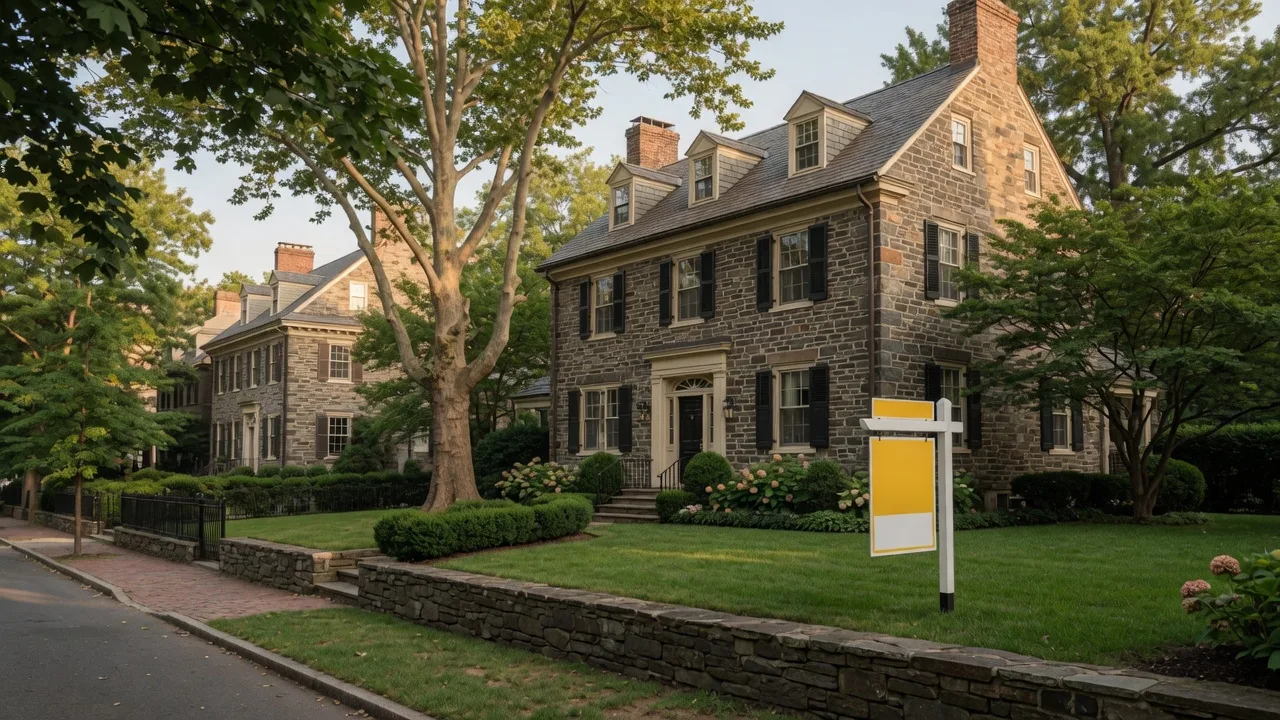
Chestnut Hill remains one of Philadelphia's most desirable and expensive residential neighborhoods in 2026, with a real estate market that reflects its unique combination of historic charm, suburban tranquility, and urban connectivity. This market update provides current data on home prices, inventory trends, days on market, and what buyers and sellers can expect in the months ahead. Whether you are considering buying, selling, or just curious about your home's value, this guide offers the latest insights from the Chestnut Hill real estate market.
Key Takeaways
- +Median home values in Chestnut Hill (ZIP 19118) sit at approximately $834,000 with 1.7% year-over-year appreciation, reflecting stable and sustained demand.
- +Average days on market range from 13 to 41 days, significantly faster than the national average, with well-priced homes receiving multiple offers.
- +Spring 2026 saw a significant surge in new listings across Northwest Philadelphia, the biggest listing quarter in a year, providing more options for buyers.
- +Considering selling? Visit our home valuation page for a free market analysis tailored to your Chestnut Hill property.
Market Overview: Summer 2026
The Chestnut Hill real estate market in mid-2026 is characterized by constrained inventory, steady buyer demand, and price stability with modest appreciation. The neighborhood scored 92 out of 100 on Redfin's competitiveness index, indicating a strong sellers market where well-priced properties attract competition. The market has been shaped by several converging factors: Chestnut Hill's enduring reputation as Philadelphia's premier historic neighborhood, limited new construction due to the historic district's preservation constraints, and increasing interest from buyers seeking more space and green surroundings in the post-pandemic era.
A notable development in 2026 has been the spring surge in new listings. Sellers in Chestnut Hill and surrounding Northwest Philadelphia communities listed 520 homes between April and June 2026, representing the biggest listing quarter in over a year. This injection of inventory has provided welcome options for buyers who have been frustrated by the historically tight market, though overall supply remains below what would be considered a balanced market. The summer market has continued to show robust activity, with 7 new listings, 11 homes sold, and 5 pending sales reported in July 2026 alone according to local market data.
Home Prices and Valuation Trends
Chestnut Hill's home values reflect its status as one of Philadelphia's most prestigious neighborhoods. The median home value in the 19118 ZIP code stands at approximately $834,000, with year-over-year growth of 1.7% according to recent market data. Median list prices as of mid-2026 are around $862,000, while median sold prices have ranged from $919,680 to $1,250,000 depending on property type, size, and condition. The wide range reflects the diverse housing stock, from modest twins and condos to grand estate homes on large lots near the Wissahickon.
When looking at specific property categories, Victorian twins and duplexes typically range from $500,000 to $800,000 depending on condition and location. Stone colonials and single-family detached homes, particularly those in the historic district, command $800,000 to $1.5 million and up. Luxury estate properties with significant acreage or particularly fine architectural details can reach $2 million or more. Condominiums along the Germantown Avenue corridor offer more affordable entry points, generally ranging from $250,000 to $600,000 based on size, amenities, and building quality. The trailing twelve-month median sale price according to Homes.com is approximately $925,000 to $930,000, representing roughly 19% appreciation from the prior year, though this figure reflects the mix of properties sold rather than pure appreciation across all properties.
Inventory and Days on Market
Inventory in Chestnut Hill remains constrained by historical standards, though the spring 2026 surge has provided some relief. The number of active listings has fluctuated between approximately 36 and 51 homes for sale at any given time during 2025 and 2026, representing roughly two to three months of supply at current sales pace. This is well below the five to six months of supply typically considered a balanced market, reinforcing Chestnut Hill's status as a sellers market. The limited inventory is partly structural: Chestnut Hill's historic designation restricts new construction, and homeowners who do list often face decisions about whether to sell after many years of ownership.
Days on market vary significantly by price point and property condition. Well-priced homes in move-in condition average 13 to 24 days on market, with many receiving offers within the first two weeks of listing. Properties that need significant updating or are priced aggressively can sit for 40 to 90 days before finding a buyer. The overall average days on market for Chestnut Hill is approximately 38 to 41 days, which is faster than the national average of 54 to 56 days but slightly longer than the ultra-fast pace seen during the pandemic-era market frenzy. The market is functioning efficiently: properly priced homes sell quickly, while overpriced properties linger and often require price adjustments to attract serious buyers.
Property Types and What Is Selling
Chestnut Hill's housing stock is remarkably diverse, and different property types appeal to different buyer segments. Historic stone colonials and Victorian twins are the most sought-after property types, particularly when they have been thoughtfully updated with modern kitchens, bathrooms, and systems while preserving original architectural details. These properties attract families and professionals who value character and are willing to pay a premium for move-in condition. Renovated condos along Germantown Avenue, particularly in buildings like the Chestnut Hill House and newer boutique developments, appeal to downsizers, empty nesters, and first-time buyers who want the Chestnut Hill lifestyle without the maintenance burden of a historic home.
The luxury segment of the market, comprising homes priced above $1.2 million, moves more slowly but remains active. These properties tend to be unique estate homes with significant acreage, exceptional architectural pedigree, or prime locations adjacent to the Wissahickon or Morris Arboretum. Buyers in this segment are often relocating from other high-cost markets or trading up from smaller homes within the neighborhood. The key for sellers across all price points is realistic pricing based on recent comparable sales and professional staging that highlights the unique character of Chestnut Hill homes while presenting them in their best light for today's discerning buyers.
Buyer Profile and Demand Drivers
The typical Chestnut Hill buyer in 2026 falls into one of several categories. Families with school-aged children are the largest buyer segment, drawn by the excellent public and private school options including Armstrong Elementary, Springside Chestnut Hill Academy, and progressive options like The Crefeld School. A second major segment comprises professionals and executives who work in Center City or the northwestern suburbs and value the train commute and Chestnut Hill's village atmosphere. A third segment is downsizers, often empty nesters selling larger Main Line or suburban homes and seeking the walkability and cultural amenities of Chestnut Hill's Germantown Avenue corridor, frequently in condo or carriage house properties.
The neighborhood's demand drivers remain strong and durable. The Wissahickon Valley Park and Morris Arboretum provide unparalleled access to nature. The Chestnut Hill Business District's independent shops, acclaimed restaurants, and year-round events create a vibrant community fabric. The two SEPTA Regional Rail lines offer reliable transit connectivity. And Chestnut Hill's reputation for safety, strong civic engagement, and community identity continues to attract buyers who want an authentic neighborhood experience within Philadelphia. These fundamental strengths suggest that Chestnut Hill will remain one of Philadelphia's most desirable real estate markets for the foreseeable future.
Outlook for the Remainder of 2026
Looking ahead to the fall and winter of 2026, several trends are likely to shape the Chestnut Hill market. The spring listing surge suggests inventory may remain healthier than in recent years, giving buyers more choices while still favoring sellers due to overall supply constraints. Interest rates, which have been a significant factor in real estate markets nationwide, continue to influence buyer purchasing power and monthly payments. However, Chestnut Hill's buyer base tends to be less rate-sensitive than many markets, with many buyers bringing substantial equity from previous home sales or making larger down payments. Prices are expected to remain stable with modest appreciation in the 2-4% range for the full year, barring major macroeconomic shifts.
For sellers, the key to a successful sale remains pricing accurately from the start and presenting the property in its best condition. For buyers, preparation is essential: getting pre-approved, understanding the competitive landscape, and working with an agent who knows Chestnut Hill's nuances will be critical to securing a home in this desirable neighborhood. Whether you are planning to buy, sell, or simply track your investment, staying informed about local market conditions is the best strategy for making smart real estate decisions in Chestnut Hill. For a personalized market analysis of your Chestnut Hill property, visit our home valuation page.
Common Questions
Are home prices in Chestnut Hill still rising?
Yes, prices continue to show moderate appreciation with 1.7% year-over-year growth. The market is stable rather than booming, reflecting a healthy and sustainable local real estate environment.
Is now a good time to buy in Chestnut Hill?
For buyers planning to stay in the neighborhood for several years, any time is a good time given Chestnut Hill's track record of steady appreciation and enduring desirability. Spring 2026's inventory surge has improved options for buyers compared to recent years.
What should I expect during a Chestnut Hill home inspection?
Given the historic nature of most Chestnut Hill homes, inspections commonly address older systems (electrical, plumbing, HVAC), foundation issues in century-old structures, and potential lead paint or knob-and-tube wiring concerns. A specialist familiar with historic properties is recommended.
How do Chestnut Hill prices compare to nearby communities?
Chestnut Hill commands premium prices compared to neighboring Mt. Airy and Germantown but represents good value compared to comparable Main Line communities like Bryn Mawr or Gladwyne, where similar historic homes often cost 20-40% more.
What is the property tax rate in Chestnut Hill?
Philadelphia's property tax rate applies uniformly across the city, with assessments based on the Office of Property Assessment (OPA) valuations. Chestnut Hill homeowners should verify their specific assessment and are eligible for the city's homestead exemption.
Explore More
External Resources
